Last updated: October 11, 2026
Key Takeaways
- Different tools save time at different stages: one cleans, the other creates.
- Use a grammar checker when you already have text and want cleaner copy.
- Use an AI writer when you need a draft, rewrite, or several versions quickly.
- For editing jobs, start with a checker; for drafting jobs, start with an AI writer.
FTC disclosure: I may earn a commission if you buy through retailer links, at no extra cost to you.
Quick Answer: for the grammar checker vs AI writer: which tool solves which problem, the split is simple: one helps polish text you already have, and the other helps create text you do not. If your sentence is already on the page, pick the checker; if the page is empty, pick the AI writer.
I compared the grammar checker vs AI writer: which tool solves which problem using published product documentation, vendor help pages, and independent reviews, and I looked for the features that actually map to editing or drafting.
First published 11 October 2026.
Verdict

A grammar checker is the better buy for anyone whose main pain is correcting existing prose, while an AI writer is the better buy for anyone who needs help producing a first draft or a full rewrite from scratch.
That is the short answer. The longer version is this: one tool polishes language you already have, the other generates language you do not yet have. If your team publishes under style rules, brand rules, or compliance rules, the checker usually matters more at the end of the workflow; if your bottleneck is blank-page paralysis, the AI writer usually saves more time at the start. Honest trade-off? Control versus speed.
Quick spec table
| Decision factor | Grammar checker | AI writer |
|---|---|---|
| Core job | Catches errors in text you wrote | Produces or rewrites text from a prompt |
| Best use case | Proofreading, style cleanup, consistency | Drafting, brainstorming, rephrasing, outlining |
| Output risk | Misses deeper meaning problems | Can invent facts or drift off brief |
| Control | High, because you approve every fix | Lower, because the model can choose wording and structure |
| Best for | Final pass before send/publish | Empty page, rough notes, high-volume drafting |
| Main limit | Cannot create missing ideas | Needs careful fact-checking and editing |
| Typical buying question | “Will this catch my mistakes?” | “Will this help me write faster?” |
How I compared them
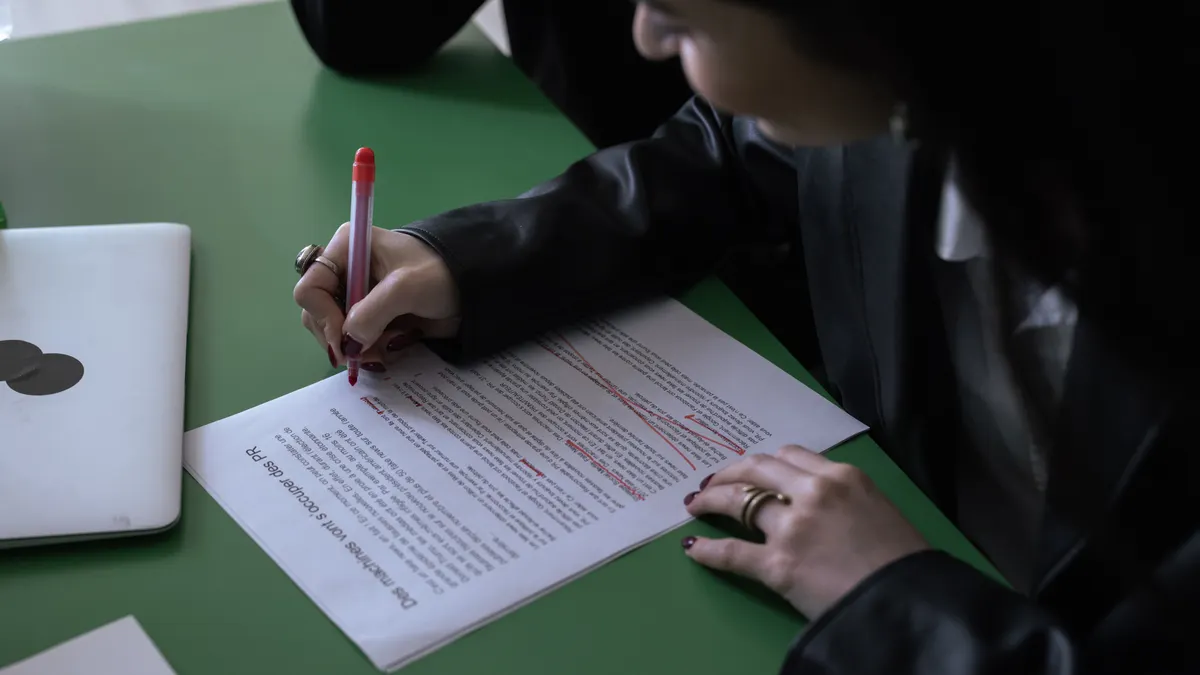
I compared the tools by the problem they are meant to solve, the kind of input they need, the amount of judgment they preserve, and the kind of failure they introduce.
Where they differ
Grammar checker wins when the sentence exists already
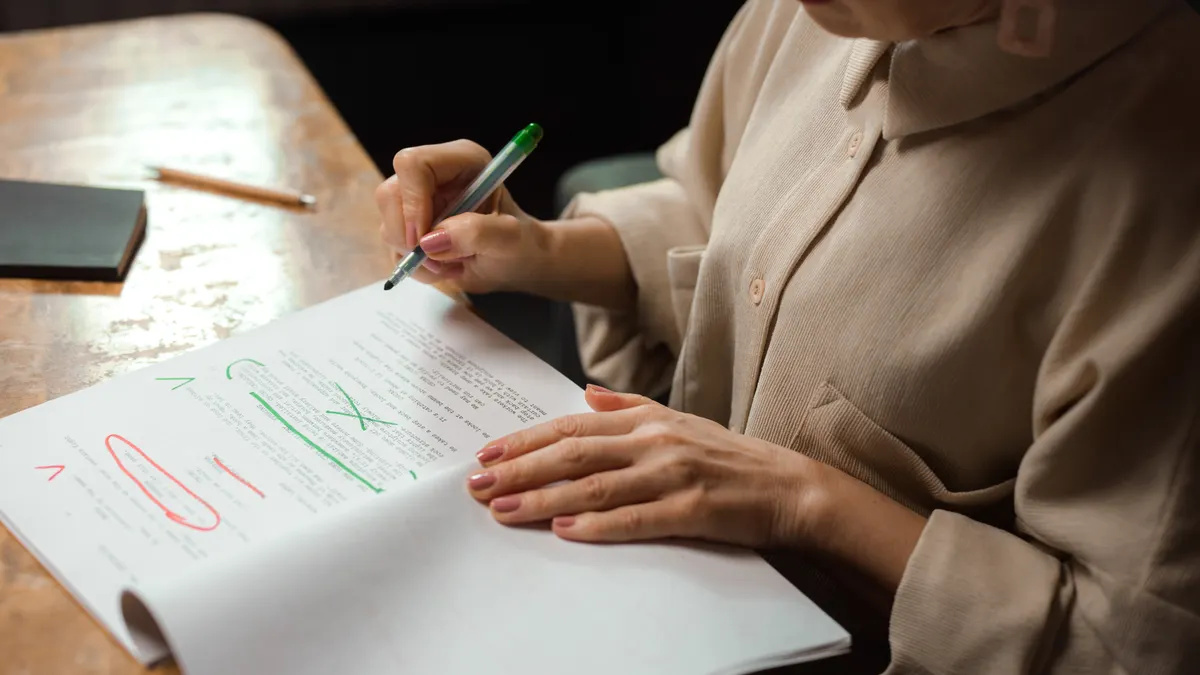
A grammar checker wins for cleanup because it is built to inspect your draft line by line and flag grammar, spelling, punctuation, style, and consistency issues without taking over the document. That is its whole lane.
That matters when the text must stay recognizably yours. Editing a proposal, policy memo, legal-adjacent document, product page, or email thread usually calls for targeted corrections, not a brand-new draft. Grammar tools are also easier to trust in regulated or brand-sensitive work because their job is smaller: they suggest edits to the text in front of them instead of inventing a new version. Like a mechanic tightening bolts, not rebuilding the engine.
The limit is plain. A checker cannot rescue weak thinking. It can fix “their/there/they’re,” but it cannot tell you that the argument is thin or that the structure is upside down. If the draft is fundamentally bad, a checker only polishes the surface.
AI writer wins when the page is empty
An AI writer wins when the problem is generation, not correction, because it can turn a prompt, outline, notes, or source material into a usable first draft.
That is the difference most buyers miss. Grammar software assumes you already know what you want to say. AI writing software assumes you need help deciding how to say it, or even what the next paragraph should be. For marketers, founders, students, support teams, and content teams facing volume, that can be more useful than sentence-level correction.
The trade-off is obvious: the more the tool writes, the more you must check. AI writers can flatten voice, repeat themselves, miss nuance, and sometimes state things too confidently. If accuracy matters more than speed, the extra draft output becomes extra review work, not free labor.
Grammar checker wins on control
A grammar checker wins on control because it keeps the user in the driver’s seat and generally offers suggestions rather than wholesale rewrites.
That is useful when exact wording matters. A contract summary, a customer-facing policy note, or a sensitive internal memo often needs a careful hand, not a remixed paragraph. Even when a grammar checker suggests style changes, the user can reject every one of them and keep the original line.
The downside is that control can mean limited help. If the draft needs a stronger lead, a clearer order, or a more persuasive angle, the checker will not supply that bigger fix. It notices errors; it does not redesign the message.
AI writer wins on speed for first drafts
An AI writer wins on speed for first drafts because it can produce usable copy from a short brief in seconds rather than asking the user to build each sentence manually.
That matters most in repetitive work: product descriptions, FAQ variants, social captions, ad options, email subject lines, and outline expansion. The value is not just typing faster. It is skipping the blank page and getting to something editable sooner.
The drawback is that speed can create junk at scale. If the prompt is vague, the output often is too. If the facts are sensitive, the model may sound fluent while being wrong. Fast drafting only helps if the next step includes human review.
Grammar checker wins for final pass publishing
A grammar checker wins for final-pass publishing because it is better suited to catch small errors that survive earlier editing rounds.
That final pass is where a missing comma, repeated word, awkward verb agreement, or inconsistent capitalization can still slip through. If you publish newsletters, blog posts, knowledge-base pages, or client deliverables, those tiny errors are often the last thing standing between “done” and “drafty.” Grammar tools are built for that stage.
But they are not a substitute for editorial judgment. They may flag perfectly acceptable style choices, and they can miss real problems if the sentence is grammatical but the meaning is wrong. The more specialized the writing, the more likely the tool will miss what matters most.
AI writer wins when you need variation, not just correction
An AI writer wins when the job is to produce multiple versions of the same idea, because it can generate alternatives quickly.
That is useful for headlines, subject lines, ad copy, summaries, and tone shifts. Instead of polishing one sentence, you ask for five versions and choose the one that fits the channel. For teams that A/B test copy or adapt the same message across formats, that is a real workflow advantage.
The weakness is that variation is not the same as judgment. Ten generated options can still be ten mediocre options if the brief is weak. And because the model can sound polished even when it is generic, the burden shifts to the human to spot sameness and rewrite the bland parts.
What they share
Both tools reduce editing time, but they do it at different points in the process.
Both can run inside web apps, desktop apps, browser extensions, or writing assistants embedded in larger suites. Both can support individual writers and teams. Both can make average writing cleaner. The difference is that a grammar checker mostly improves what you already wrote, while an AI writer often replaces part of the writing process itself.
Both also carry a trust cost. With either tool, the user still needs to read closely. A grammar checker can overcorrect style or miss a deeper issue. An AI writer can produce plausible but inaccurate prose. In both cases, the tool helps most when the human remains the editor.
Get the grammar checker if …
A grammar checker is the right choice if your main job is to clean up text that already exists, not to generate fresh copy.
Buy this if you send a lot of emails, publish content under a house style, edit reports, or need a safety net before hitting send. It is also the safer pick if you care about preserving your own voice, because you can keep the structure and accept only the fixes you want. For teams with approval chains, the smaller scope is a feature, not a weakness.
The listing and product page should make clear whether it covers spelling, grammar, punctuation, style, and plagiarism or only a subset of those features; that detail changes how much work it can remove.
Pros
- It catches surface errors in a finished draft, so a final proofread takes less time.
- It usually suggests edits rather than replacing whole paragraphs, which means you keep tighter control over tone and meaning.
- It is better suited to brand-sensitive or compliance-sensitive copy, where preserving exact wording matters.
Cons
- It cannot create missing ideas, so a weak argument stays weak even when the grammar is clean.
- It may miss context problems, which means a sentence can still be wrong even after every suggestion is accepted.
- If the tool only covers grammar and spelling, you still need another step for structure, tone, or ideation.
Buy this if your bottleneck is cleanup after you have already written the thing. Skip it if your real problem is starting from nothing or reshaping a rough concept into a full draft.
One honest weakness of grammar checkers
The biggest weakness is that they can make finished prose look more final than it is. A clean sentence is not always a clear sentence, and a checker can create false confidence if the message itself is muddled.
Get the AI writer if …
An AI writer is the right choice if your main job is to produce a draft, a rewrite, or multiple variations faster than you can do them manually.
Buy this if you need outlines, first drafts, summaries, ideation, or content at volume. It is especially useful when the task is repetitive and the cost of a rough first pass is lower than the cost of staring at a blank screen. For content teams, support teams, and solo operators who need speed, the output can be the difference between shipping and stalling.
The listing and product page should say how much control you have over tone, length, sources, and citation handling, because those controls determine whether the tool is a helper or a risk.
Pros
- It can turn a short brief into draft text, so the blank-page stage is shorter.
- It can generate several versions of the same idea, which is useful for testing tone or channel fit.
- It can expand notes into structure, so research and drafting move in one flow.
Cons
- It can sound confident while being wrong, which means fact-checking stays mandatory.
- It can smooth away voice, so all your drafts start to sound alike.
- If the prompt is weak, the output is often generic, which means the tool saves typing but not thinking.
Buy this if you need help making text, not just fixing it. Skip it if the content is high-stakes and you need the smallest possible risk of invented detail.
One honest weakness of AI writers
The biggest weakness is that they can create fluent nonsense. That is not a small flaw; it means the output can look ready before it is trustworthy.
FAQ
Is a grammar checker enough for professional writing?
Yes, if the only problem is surface correctness; no, if you also need ideas, structure, or tone changes.
Can an AI writer replace a grammar checker?
Not reliably. An AI writer can rewrite text, but that does not make it a precise proofing tool.
Which is safer for factual work?
A grammar checker is safer because it changes less. An AI writer needs tighter review because it can introduce errors while sounding polished.
Which one should a student use?
A grammar checker is better for polishing essays already written, while an AI writer is better for brainstorming or outlining. For academic work, check your school’s rules before using either tool.
Which one should a marketing team choose first?
If the team already has drafts and needs consistency, start with a grammar checker. If the team struggles to produce enough copy, start with an AI writer.
Final verdict
For most readers, the grammar checker is the better first purchase if the job is editing, and the AI writer is the better first purchase if the job is drafting.
The condition that flips the decision is simple: if you already have text, choose the checker; if you need text created or recast, choose the AI writer. If your workflow has both problems, a common setup is one tool for generation and one for cleanup, with a human read-through before anything goes live.
Drafted with AI; not yet reviewed by a person.